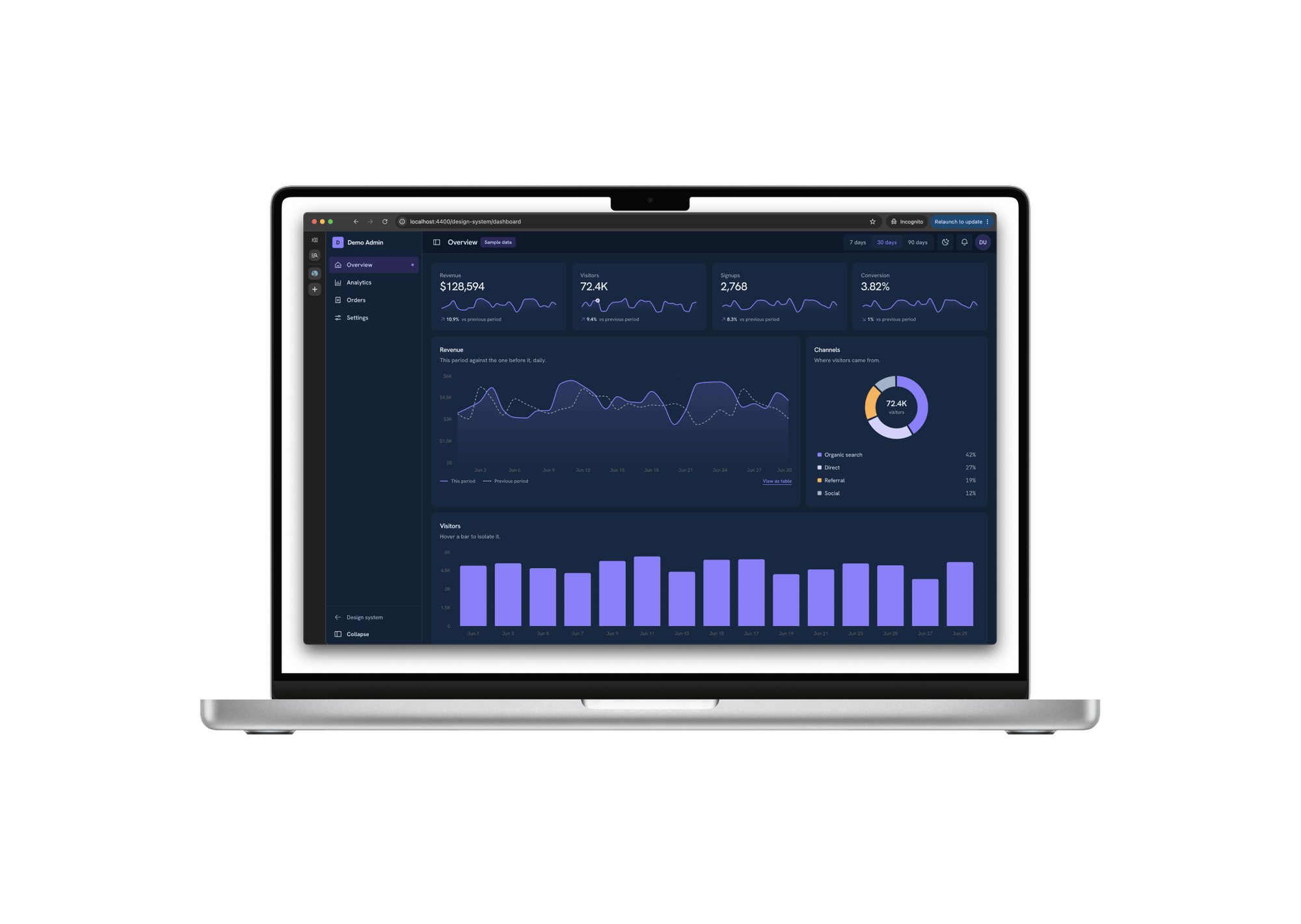
The design system page is the design system itself, not a description of one. Nothing on it is a screenshot or a copy: components render from their real source files, and the tokens are parsed out of global.css at build time.
The problem
Most design-system documentation rots. Someone changes a token or adds a component, the docs page does not move, and within a quarter it describes a site that no longer exists. I wanted the opposite: a page that cannot disagree with the code, and checks that fail when it tries.
What I built
- Foundations read from the theme. Color roles, light and dark values, contrast ratios, shadows and the radius scale come from parsing the stylesheet, so a token change shows up on the next build with no edit to the docs.
- Every component, live. Primitives, composites and page patterns render from the same files the site uses, each with its source path, variants and a usage note. A registry plus a test fails the build if a component file exists that is not documented or explicitly omitted.
- A real dashboard. A full-window admin demo with a collapsible sidebar, mobile sheet, stat cards and animated charts, built on shadcn patterns and mapped onto the site tokens instead of importing a second color system.
- Accessible navigation. Tabs are anchors first, so the page works without JavaScript; with it, they become a proper tablist with arrow keys and deep links.
The guardrails
- Token check. A build script fails if any theme color is missing its channel companion in light or dark, which is what makes opacity utilities work in both themes.
- Types and tests.
astro checkand a unit-test suite cover the pure logic: filters, pagination, count-up math, image variants, nav menus, the headers generator, the tab and token helpers. - Security headers. A CSP is generated at build from the hashes of every inline script in the final HTML, so adding a script or a chart library cannot silently break production. The page prints the real policy from the same module that writes it.
- Accessibility rules. Skip link, one focus ring, state never carried by color alone, a reduced-motion branch for every animation.
Performance
Images go through a pipeline that measures quality rather than assuming it: each WebP variant must clear a PSNR, mean-error and 99.9th-percentile-error bar against the source, or the encoder steps up, down to lossless. Load order is a set of recorded decisions: inlined CSS, a preloaded latin font, island runtime deferred past first paint, hydration chosen per island, and the heavy chart bundle isolated to the one page that needs it.